The enduring enchantment of Metsaülikool
Maimu Mölder, one of the organisers of the Kotkajärve Metsaülikool in Canada, writes how the significance of the nearly 60-year event extends far beyond lectures and discussions.
“Gratitude.” “Warm feelings.” “A life-changing experience!” “Magnificent time.”
These are some of the words participants used to describe how they felt after Metsaülikool at Kotkajärve this past summer. People come to Metsaülikool to hear lectures, discuss important topics and learn something new. But when the week is over, what often stays with participants longer is something else entirely – the people and the feeling of being together.
Old friends and new acquaintances who become friends. The Estonian language all around you. The forest and the lake. Laughter, music and dancing. Long conversations and thoughts that you take home with you.
This year, participants were especially delighted by the presence of young people from around the globe who brought along with them an infectious energy and fresh perspectives to Metsaülikool – and showed that Estonian identity continues to thrive when given the opportunity to meet, grow and express itself.
One participant wrote: “I left with an extraordinarily wonderful feeling.” Another: “With the very best feelings.” And perhaps one simple sentence says the most: “I still want to be in nature.”
Over sixty years, the world, Estonia and the people of Metsaülikool have changed. The topics and discussions have changed. But something important has remained the same.
People come to Kotkajärve because of the friendships they will make and for the strengthened bond to their culture – and leave with the feeling that they are part of a greater Estonian community.
That is the enchantment that is Metsaülikool. It is a feeling that is difficult to describe, but one you recognize the moment you arrive at Kotkajärve.
Perhaps that is why we keep coming back.
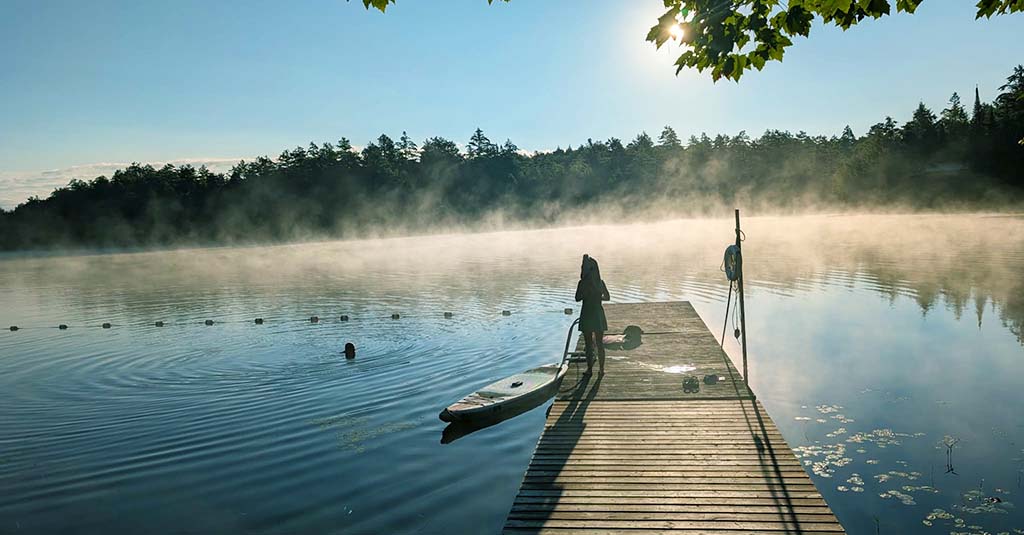
Kotkajärve
A few things make Metsaülikool particularly distinctive.
1. It has an extraordinary 60-year continuity
It was the 1960s, a time of profound social and cultural change that reshaped society. Estonians in their 20-30s in North America wanted to deepen their knowledge of all things Estonian while maintaining their connection with Estonian language and culture, so they created the opportunity for themselves. The first Metsaülikool took place at Kotkajärve, Muskoka, Canada in August 1967.
2. It takes place in the forest — and that actually matters
The physical setting is not just a backdrop. Kotkajärve is a 50+ hectare wilderness property in Muskoka, with forest, lake, campfires, sauna and rustic accommodation.
People eat together, go for walks, attend lectures, argue their ideas, go to the sacred grove, and can learn some folk dances together. The boundaries between “academic program” and “community” disappear.
That creates the famous MÜ vaim (spirit) — something that is difficult to reproduce in a Toronto hall or conference centre.
3. It combines serious thinking with informality
This is perhaps one of its greatest strengths.
MÜ was deliberately founded as an intellectually-minded, apolitical forum dealing with Estonian culture, science, politics and society.
But the lecturers, artists, politicians, writers and participants aren’t sitting behind a podium all week. Everyone is simply part of the same community. Traditionally, everyone uses the less formal “sina”-form of addressing attendees.
So you can have a serious discussion about Estonia’s future in the morning, go swimming, sit in the sauna, have coffee with the speaker and sing together around a campfire that evening.
4. It is a place where Estonia and the diaspora meet as equals
This is particularly important historically.
MÜ was created in Canada by the diaspora, during the Russian (Soviet) occupation, but it never defined Estonian culture as something belonging only to people living outside Estonia. One of its founding principles was that the Estonian people and culture constitute a whole regardless of where Estonians live.
Over the decades, speakers and participants have come from Estonia and from Estonian communities around the world. The MÜ model itself subsequently inspired Metsaülikool activities elsewhere, including in Estonia.
So it has functioned as a kind of bridge between Eesti and väliseesti.
5. It is a think tank and incubator for new ideas
This is, in my view, especially important for the future of MÜ.
Metsaülikool has historically been a place to ask:
What does it mean to be Estonian?
What kind of Estonia do we want?
What does Estonian culture become in a changing world?
Its programs have dealt with politics, history, literature, identity, language, culture, science and contemporary social questions. The goal isn’t simply to teach people about an Estonia that existed 50 or 100 years ago. It is a place for thinking about what Estonianness can become next.
6. It has created relationships, not just programs
Someone might forget a lecture from ten years ago.
They are less likely to forget their dance partner that they hit it off with from folk dance lessons. That social dimension is fundamental. The 2026 MÜ feedback survey, for example, specifically noted the remarkable presence of young people with Estonian roots from different countries and saw that as evidence that Estonian identity remains meaningful to a younger generation.
And that is probably one of MÜ’s greatest achievements: it inspires the next generation of people who care about Estonia and about each other.
7. And perhaps the most special thing: it shouldn’t really exist — but it does
A diaspora organization founded in 1967, in the middle of the Cold War, creates a week-long Estonian-language intellectual and cultural gathering on a Canadian boreal forest property.
It survives for almost 60 years.
Generations come and go. Estonia becomes independent. Technology changes. The diaspora changes. The reasons for coming change.
But people still drive north to Kotkajärve.
That is what makes Metsaülikool special.
It isn’t simply an organization that has survived for 60 years. It has remained relevant by continually reinventing what it means to be Estonian together.
And I think that is a very strong foundation on which to build the 60th anniversary MÜ in 2027: not just “60 years of Metsaülikool,” but 60 years of ideas, friendships, cultural exchange and imagining the future of eestlus.