From Sydney to California, 24/7 online - How is being Estonian expressed in the digital age?
Estonian communities around the world are almost always linked by at least one social media channel. In earlier waves of migration, people gathered around the church or the local Estonian choir. In today’s digital world, there are hundreds of Facebook groups, WhatsApp channels and mailing lists for Estonians abroad - forming a network that connects people who identify as Estonian and their families. Since the restoration of Estonia’s independence, discussions have continued on how to connect the Estonian diaspora communities with Estonia. The results of my ten years of migration research show clearly that the only way to bring Estonians together across the world is virtually. The global Estonian community is both practical and emotional, and with these two needs in mind, it is possible to sustain and create channels through which 100,000 Estonians and people of Estonian descent living abroad can stay informed and connected.
Although virtual Estonian communities exist all over the world, every cell in this global digital network also functions like its own tribal branch. Groups differ in character and purpose. Some gather all Estonians living in a country, like Eestlased Norras (Estonians in Norway), others are tied to specific regions, such as Eestlased Balil, while others form around a more specific focus - for instance, Eesti naisettevõtjad Soomes (Estonian women entrepreneurs in Finland). These virtual spaces - inhabited by Estonians living around the world and used with varying intensity - operate on self-organised, unwritten rules and change continuously over time. Each community reflects its most active members at any given moment and responds to the needs that arise at different stages of life. Australian groups are filled with backpackers looking for short-term work, housing or friends; in Finland, WhatsApp networks help youth organise meet-ups; and many groups revolve around schools and children’s activities, aimed at bringing families together who want to pass on Estonian language and culture.
At the same time, social media enables Estonians living and travelling worldwide to stay connected to their homeland. These channels work both ways - they create Estonianness abroad and also bring Estonian news into diaspora media spaces, whether it's an athlete’s medal, business success or developments on the frontlines in Ukraine. Social media spaces are supported/complemented/accompanied by the Global Estonian web portal, numerous websites and digital publications - online magazines, newspapers and mailing lists. Each channel has a role in supporting Estonian life across countries and continents. These platforms, maintained largely through volunteer work, and the active efforts of administrators - translating, moderating and sharing information - form a digital networkthrough which Estonians can meet and connect virtually.
Practical questions and everyday life
Estonian groups abroad function as marketplaces of sorts. Everyday needs show how important it is to find an Estonian-speaking hairdresser, builder or babysitter - and also to offer one’s own skills to others. Almost every community has its own cake-baker, bread-maker and verivorst (blood sausage) provider. One of the first questions for any newly arrived Estonian is how to find familiar flavours and reliable services in a new society. The foundation of a successful virtual community is meeting everyday needs. Everywhere in the world, Estonians search for Estonian bread, candy, keefir, verivorst and beer - and exchange tips on what tastes best in the local shops.
Countries where Estonian migration is high, earlier arrivals often have long experience helping newcomers. Some digital communities are now slightly worn out from helping so many. Support is given - but selectively - prioritising those clearly in serious need. After years of experience, helpers in places like Australia and Finland know their limits well and enforce them. Adelaide Estonian House has community rules for backpackers; Finnish-Estonian online groups can be sharp-tongued toward newcomers - yet in the end, someone still steps up to help a fellow Estonian in trouble.
Trust between group members is remarkable. Around the world, people entrust fellow Estonians with ID cards, money, even pets and children. Living far from family and friends, asking for help becomes inevitable at times. Fellow Estonians met in a moment of vulnerability can quickly become a close friend, an anchor - even a kind of chosen relative, with a bond stronger than in some biological families. Many groups show people closely following one another’s lives and building lasting friendships. Especially in places where Estonians are few, geographically dispersed or younger, finding and keeping friends is vital.
Like a marketplace, language matters in these social media groups. Posts often begin with “Hello dear fellow Estonians!”, and expressions of gratitude are common. Each group is shaped by its environment - Finnish groups include Finnish memes; Australian ones local slang and abbreviations. In some spaces, information appears in multiple languages to ensure that children of Estonians, cultural enthusiasts or friends of Estonia do not miss out.
Author/ Source: Screenshot of a Facebook group connecting Estonians in Finland
Social media spaces are not always soft landings. The more Estonians in one country, the more diverse - and sometimes more demanding - the tone. As anthropologist Jaanika Kingumets and I have observed, Finnish-Estonian social media often acts as a testing ground, where newcomers must prove they are arriving with good intentions and willingness to make an effort - so the community’s reputation is not tarnished. This attitude is reflected in comments like “No more Estonians needed here,” “People come here to embarrass us,” and “At least Google before you ask.” Spelling mistakes, superficial questions and user profiles are mocked. Migration scholars have long noted that the most sceptical toward new arrivals are those only recently settled themselves (Alho, Sippola 2019), who may feel newcomers threaten their hard-earned place in society.
Celebration and recognition
Whether in Egypt, Sydney, Cologne or California - Estonians everywhere celebrate Independence Day and Midsummer. Events range from karaoke nights to formal dinners and speeches. In one Egyptian group I once saw: “Let’s celebrate Independence Day on February 24th with a karaoke-style group anthem. The brave will sing on stage, the rest will cheer - let’s keep the flag flying high!!”
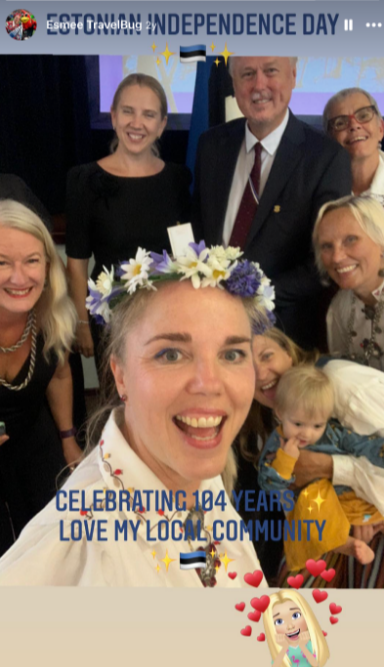
Author/ Source: Esmée Okamoto, from the author's private collection
Choirs and folk dance groups are active across the globe. Information about rahvariided (folk costumes) remains especially popular - which stripes belong to which region, how to tie a belt, where to learn how to sew the costumes yourself. Visual details, from flower crowns to patterned belts, shine through photos and videos thanks to the dedicated organisers whose work has helped Estonian folk culture flourish even more vividly online - for fellow Estonians and for local audiences. As one interviewee I met in Australia said: “Our folk costumes are so colourful - it’s pure joy to share those bright photos on Facebook and Instagram.”
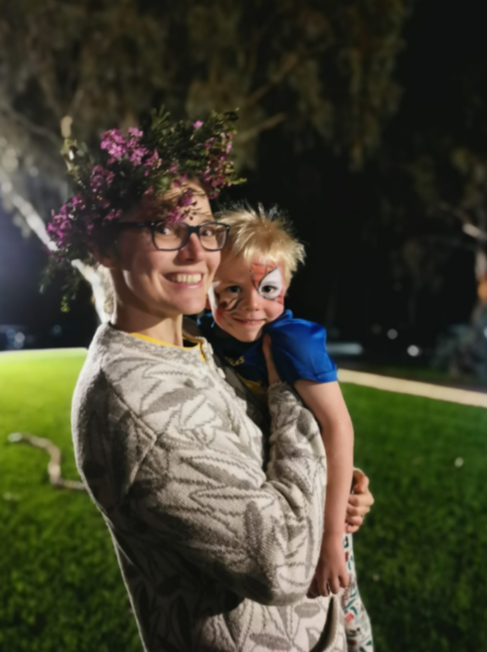
Author/ Source: From the author's private collection
Some holidays demand crowds. Midsummer (jaanipäev) is one such event. In the Netherlands, where Estonian students often have exams during that time and cannot travel home, they gather to light a bonfire. In Finland, Midsummer traditions are cherished; in Australia, friends and I have compared for years whose flower crown is most impressive. The seasonal contrast in Australia even creates a playful twist - some families celebrate "Christmas in July" instead, because July is mid-winter there. One can put on a sweater and suddenly, Australian winter feels like Estonian summer.
You don’t need a holiday to celebrate. Estonians cheer together for every Olympic medal, business breakthrough - be it Skype, Wise, or the solar-powered student-built Solaride. Even small successes create collective joy. In large countries like the USA and Australia, being part of a small nation feels like a privilege - a reminder that every individual counts. It’s no surprise that a marathon runner with Estonian roots, who has lived abroad half a lifetime, still runs under the Estonian flag and shares achievements online proudly as an Estonian.
Exchanging experience and life wisdom
For many today, migration begins on Facebook. Even young people who think the platform is for “old people” still make accounts to access the decades of accumulated knowledge in diaspora groups. Long before moving, they read discussions, join groups and begin settling in from afar with community support. These groups were born from need and have continually evolved along with their members.
New arrivals are rarely active in broader society at first - they must find housing, work, friends. Even in countries with large Estonian populations like Finland, only a few engage in local politics or take on public roles. Yet in nearly every country, social media reveals informal helpers - people who seek out those struggling and help them get back on their feet. Integration and personal stability are preconditions for becoming a helper, cultural ambassador and connector. Those who have settled successfully often describe community work as emotionally meaningful - something that gives life purpose.
Social media, web platforms and one-to-one communication
Transnational virtual space goes beyond social media. Alongside Facebook, Instagram and WhatsApp, people also want reliable official sources. Websites where information is collected, verified, regularly updated and systematised build trust. Across my decade of research, people have expressed a clear wish for a single central portal - a role the Global Estonian portal fulfils well. Mobile Estonians often live between countries, are similar in needs and lifestyle, and benefit from information available across languages and borders - from holiday celebrations to language learning, to returning to Estonia.
Supporting social media and official platforms is another layer almost invisible to researchers - one-to-one digital interaction. Time and time again, I am surprised that meeting an Estonian on the other side of the world reveals mutual friends. Beyond news feeds and group discussions, the true connective tissue lies in birthday messages, emails, photos and videos exchanged privately - keeping Estonians interconnected across the world.
Conclusion
Estonian digital networks are dynamic and fluid, continuously adjusting their rules and practices. They respond to newcomers, mirror social change, allow people to belong to many groups at once, and accept the rhythms of members leaving and returning. Virtual diaspora communities work like a staircase: sharing practical information, fostering networks through shared hobbies and interests, celebrating together, supporting one another - which eventually gives people confidence to become cultural carriers and community leaders. Estonian digital landscapes are practical, tinged with dark humour, yet at their core kind and ready to help in moments of need. We share holidays, pride and joy. Across countless digital meeting places, the global Estonian network spreads across every continent - reaching almost every country in the world.
Keiu Telve (PhD) is an anthropologist, a research fellow at the Department of Ethnology at the University of Tartu, a columnist for Edasi magazine, and one of the founders of the Centre for Anthropology. Keiu Telve's main research topics are transnational communities and digital participation. In the Centre for Anthropology's studies and consultations, Keiu facilitates the prominence of the voice of various Estonian communities and the resolution of key societal issues in Estonia through mutual understanding.