A long journey back to Estonia
Halliki Kreinin, who spent most of her life in Hungary, Scotland and Austria, writes about her personal story of moving back to Estonia.
I have been thinking a great deal lately about what it means to be Estonian. When I returned to Estonia in the summer of 2025 after 26 years abroad — in Hungary, Scotland, and Austria — it initially felt as though I might not quite fit in here. A character shaped in childhood within a more extrovert cultural environment tends to stand out rather quickly in any situation, and at times I even felt a kind of cultural barrier, despite the absence of any language barrier. Returning to Estonia also brought something deeper to the surface at first: that quiet sadness and historical weight that many people carry within them. Some of it seems to stem from the experiences of one's grandparents and great-grandparents. Living in the affluent societies of Western Europe, one does not have to confront that feeling on a daily basis. In Estonia, however, this historical weight is easier to share, often even without words. It is precisely that shared experience that has gradually brought back a sense of belonging and peace.
Although I was born in Estonia, we moved abroad when I was still a child. We lived initially for six years in Budapest, where my mother taught Estonian at university. My sister and I attended a historic Catholic girls' school in Budapest. There were no other foreigners in the class, and so I fairly quickly became, during lessons, a little Hungarian girl trying to blend in with the rest. At home, however, we were still Estonian. We ate rye bread and buckwheat porridge brought from Estonia, listened to Jäääär and Genialistid, and read Harry Potter in Estonian. Every summer we spent in Nõmme at our grandmother’s and grandfather’s house. At school, however, lunch consisted of sweet spaghetti with poppy seeds and rasvasai, and on the wall hung the Hungarian coat of arms and Jesus on the cross; during election campaigns a somewhat intimidating FIDESZ poster with a young Viktor Orbán would also appear there.
As a child I did not think much about how these two worlds fit together. My sister and I simply lived two parallel lives – that was our normality. At school we were a little different, and sometimes we could speak to each other in a secret language. Our identities were also bound together by a peculiar mixed language that our linguist mother tried to eradicate.
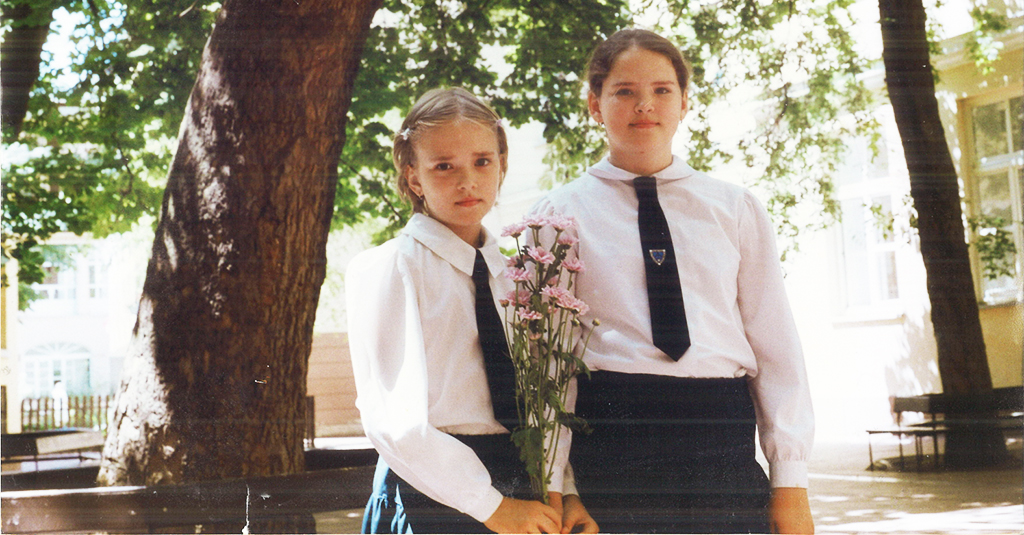
With my sister at school in Hungary in 2002 (Photo by Lea Kreinin)
The question of what it means to be Estonian became more pressing during my teenage years, when my mother was appointed as a lecturer at the University of Glasgow and we moved to Scotland. From a somewhat old-fashioned Catholic girls’ school in Hungary we suddenly found ourselves in the middle of what felt like a British teenage reality show. Whereas Hungary had strict rules — skirts had to fall below the knee, make-up was forbidden, and a school uniform resembling a potato sack was compulsory — in Scotland, most rules seemed to exist primarily to be ignored. School uniform skirts were as short as possible, girls wore high heels and heavy make-up. A police officer was constantly present at the school, searching lockers and trying to break up fights.
That environment alone would have been enough to trigger an identity crisis. But on top of that, instead of being Estonian or Hungarian, we suddenly became "Poles".
Following EU enlargement, hundreds of thousands of Polish workers had moved to Britain, and Eastern Europe had become a rather uniform category in British public life. Our school also had several pupils from Poland. During one maths lesson the teacher asked me to translate for a student who had just arrived from Poland. When I said I could not, because I was from Estonia and spoke only Estonian and Hungarian, she initially did not understand what the problem was. In the end she brought a map of Europe to the front of the classroom. I had to show where Estonia was and where Poland was. Only then did the class realise that it was not the same country.
As a teenager I felt a great deal of pride in Estonia and in being Estonian, but at the same time it was difficult to cope with the disdain and indifference that I often sensed in British society towards people from Eastern Europe. For the first time in my life I felt that being Estonian might mean being something inferior. The desire to belong to the “normal” Western Europe was sometimes so strong that I occasionally claimed to be Finnish instead, or asked my mother (rolling my eyes) not to speak Estonian so loudly in shops.
At the same time, I formed strong bonds with other pupils who were likewise not British "natives". My best friend's parents were from Hong Kong, and in the school's multicultural environment I grew close to classmates from Malaysia, Pakistan, India, and Palestine. Through them I came to know other cultures and gained an understanding of what it means to grow up between multiple identities.
That experience also taught me to notice prejudice. When you hear a middle-aged man leaning out of a car window and shouting racist abuse at your friend — who is in her school uniform — it stays with you for a long time. Such moments instilled in me a lasting sensitivity to discrimination and stereotyping.
At university the question of identity became easier again, because St Andrews had an international atmosphere. It was there that I also made new Estonian friends. We founded an Estonian society at the university and celebrated Independence Day together. Moments like these helped me understand that identity does not have to be something rigid – it can also be flexible and multifaceted, something to be cherished and shared consciously, even when one is far from home.
I later moved to Vienna for further studies. By that point I felt considerably more secure in my identity. Even so, I frequently noticed that people were more interested in the fact that I had grown up in Scotland than in my Estonian roots. Eastern Europe remained, for many, a somewhat vague and uninteresting part of the world. In Vienna I had many friends from other countries, among them Hungarians with whom I shared similar childhood memories and a mutual understanding of the differences between Eastern and Western Europe. We often spoke about how Eastern European experiences – for example relations with the Soviet Union or Russia – are simply overlooked in Western Europe.
The outbreak of Russia's war in Ukraine brought these questions into particularly sharp focus. The war stirred feelings in me that I had not previously acknowledged so clearly within myself: fear, sadness, and a historical pain that seemed to have been lodged somewhere deep inside all along. At the same time, it was sometimes difficult to understand why, for many of the people around me, it remained a distant event alongside which everyday life could carry on almost unchanged. I tried to help Ukrainian refugees as much as I could — many of whom made their way to Vienna as well. Through this I formed new friendships with Ukrainians, with whom there was often a quiet, unspoken understanding. I came to realise how profoundly historical experience shapes the way we perceive such events. That experience also changed my own relationship with Estonia. I felt more clearly that I belonged to the historical and cultural world of Eastern Europe, and for the first time I was proud of that.
At the same time, it led me to think more broadly about how different wars in Europe and around the world are perceived. I had grown up with a friend of Palestinian origin, and watching events unfold in Gaza, I found it deeply unsettling how abstract discussions about war and violence can become — particularly when that violence is directed at children the same age as my friend had been. For people living in prosperous societies, these issues often appeared merely as distant academic or political debates.
In moments like these, I am gripped by a fear that the same indifference might one day fall upon us. That bombs might fall on Estonian towns, schools, and children, while people elsewhere in Europe discussed it from a safe distance, over a glass of wine, carrying on with their daily lives regardless. And so I felt a growing need to return to Estonia.
When I finally moved back to Estonia to begin working on the SustainERA project at Tallinn University, I gradually realised how all these experiences – a childhood in Hungary, adolescence in Scotland and the years spent in Vienna – had shaped my understanding of what it means to be Estonian.
People tend to categorise others very quickly, and it is easy to lump entire regions or peoples together. Empathy often arises through personal experiences and through the people who matter to us. It is understandable that we may not have enough empathy for the whole world at once. In a fragmented and chaotic world, where news reaches us around the clock, we would probably go mad if we tried.
These experiences have taught me to notice and value difference, and to remain alert to prejudice. I am troubled by the growing intolerance of difference in Estonia — for instance, the recent case in which a trans woman was beaten at a bus stop and subsequently harassed by an ambulance worker, or the accounts of racism described by foreigners living and working here. I am also troubled by the indifference in Gaza, Iran, and certain signs of fatigue regarding what is happening in Ukraine, because such events are never as far from us as we would like to think. One day it could happen to us as well. Then we will need solidarity and support.
After many years abroad, it seems to me now that being Estonian does not mean (only) a language or a heritage. It means two things at once: the ability to see the world more broadly, and the capacity to recognise that particular bond which forms when people share an understanding of a common history.